
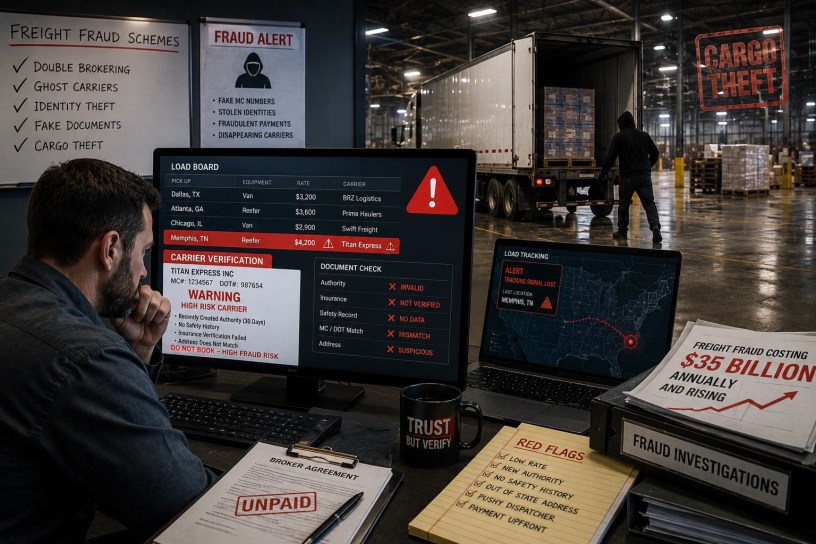
Supply chain crime has become one of the most significant and least publicly discussed risks facing the commercial trucking industry. What was once characterized primarily as opportunistic cargo theft — criminals targeting unattended trailers in unsecured parking areas — has evolved into a sophisticated, industrialized enterprise that exploits digital systems, identity fraud, and the structural vulnerabilities of a logistics network built on trust.
The financial scale is staggering. The American logistics industry loses an estimated $35 billion annually to freight fraud, cargo theft, and related supply chain crime. Cargo theft losses alone jumped 27 percent in 2024, and industry analysts have projected further increases into 2025. For trucking companies, carriers, and owner-operators who operate on thin margins in a high-compliance industry, this is not an abstract risk. It is a direct and growing threat to business viability.
Understanding how modern freight fraud works — and what practical defenses exist — has become a core operational competency for anyone managing commercial freight.
How Freight Fraud Has Evolved
The transformation of freight fraud from physical theft to identity-based digital crime tracks closely with the digitization of freight brokerage and load matching. As load boards, digital carrier onboarding, and electronic documentation became standard, criminal organizations adapted their methods to exploit the same systems that increased efficiency for legitimate operators.
The American Trucking Associations has documented a 1,500 percent increase in strategic theft using deceptive tactics since 2021 — fraud schemes that rely on identity theft, document falsification, and digital impersonation rather than physical force. The criminals executing these schemes are often operating as organized enterprises with specific roles: identity theft specialists, fake documentation creators, coordination teams, and drivers who execute the physical pickup of diverted freight.
The result is a fraud landscape where a single criminal network can simultaneously operate dozens of fraudulent carrier identities, executing pickups across multiple states before disappearing — often before the shipper or broker realizes the freight is gone.
Double Brokering: The Industry’s Fastest-Growing Threat
Double brokering has become the most prevalent and economically damaging form of freight fraud affecting the trucking industry. The scheme works by inserting an unauthorized intermediary between the legitimate freight broker and the carrier. The fraudulent broker accepts the load from the shipper or legitimate broker, then re-tenders it to another carrier — often at a significantly lower rate — pocketing the margin difference.
In its most damaging form, the double broker collects payment from the shipper, pays nothing to the actual carrier, and disappears. The carrier who hauled the freight is left with an unpaid invoice and no recourse against a party that no longer exists. The shipper may face liability for goods damaged or lost by a carrier they never vetted. The legitimate broker is caught in the middle, facing claims from both sides.
A Transportation Intermediaries Association survey found that 34 percent of respondents identified unlawful brokerage as the top fraud scheme they face — a figure that reflects how widespread the problem has become even as the industry has attempted to develop countermeasures. The FMCSA’s regulations on freight brokerage exist specifically to prevent these schemes, but enforcement has not kept pace with the volume and sophistication of violations.
Ghost Carriers and Identity Theft
Ghost carrier fraud involves the creation of entirely fictitious carrier entities — companies with no trucks, no drivers, and no legitimate business operations — that exist solely to execute fraudulent pickups. These operations construct an elaborate facade of legitimacy: professional websites with stock photography, working phone lines, fabricated insurance certificates, and DOT numbers obtained fraudulently or cloned from legitimate carriers.
The sophistication of modern ghost carrier operations makes casual verification inadequate. A carrier that appears to have a clean safety record, valid authority, and proper insurance documentation may have achieved that appearance entirely through fraud. The FMCSA’s SAFER system — the standard tool for carrier verification — can be spoofed by criminals who hijack legitimate carrier credentials or exploit the registration process for new carrier authority.
Strategic cargo theft combines elements of ghost carrier fraud with physical theft. A criminal network identifies a high-value load, constructs a fraudulent carrier identity that passes initial verification, executes a legitimate-appearing pickup, and then diverts the freight. By the time the shipper realizes the cargo is missing, the criminal operation has dissolved the carrier entity and moved on.
What Carriers Can Do to Protect Themselves
The defensive posture for legitimate carriers — who face both the risk of having their identity stolen and the risk of being defrauded as a party in a transaction — requires action on multiple fronts:
- Monitor your carrier credentials actively: Fraudsters frequently clone legitimate carrier DOT numbers and MC numbers. Subscribe to FMCSA notifications for any changes to your carrier profile. Unexplained changes to your operating authority, insurance filings, or contact information are red flags that your identity is being hijacked.
- Vet brokers before accepting loads: Verify broker MC numbers through FMCSA’s Licensing and Insurance system. Confirm that the broker holds a current surety bond — required of all licensed freight brokers. Be wary of brokers offering rates significantly above market, pressure to move freight immediately without standard documentation, or requests to divert from normal procedures.
- Use signed rate confirmations: A properly executed rate confirmation that identifies all parties, describes the freight, confirms the rate and payment terms, and specifies pickup and delivery details is the foundational document protecting carriers in fraud disputes. Never move freight without one.
- Document everything at pickup: Photograph the freight, the trailer, and any visible damage or discrepancy at pickup. Verify shipper identity against the documentation. Note any unusual circumstances. This documentation protects carriers when freight claims arise from loads they handled legitimately but that were subsequently re-tendered by a fraudulent intermediary.
- Know your payment exposure: Understand your broker’s payment terms and track payment on every load. Brokers who begin delaying payment, requesting extended terms, or going silent on invoice inquiries may be experiencing financial distress — a precursor to non-payment that fraud operations exploit.
Technology as a Defense Tool
The freight industry’s digital infrastructure — which enabled the rapid scaling of fraud — is also the environment in which the most effective defenses are being developed. Several technology categories are directly relevant to fraud defense for carriers and fleet operators:
Carrier identity verification platforms, including Highway, Carrier411, and similar services, provide deeper vetting of carrier credentials than FMCSA’s public systems alone. These platforms cross-reference carrier data against multiple sources, flag anomalies, and alert users to carriers with recent complaint activity or identity concerns — making them valuable tools for brokers and shippers vetting carriers, and for carriers verifying broker legitimacy before accepting loads.
Electronic proof of delivery (ePOD) systems create tamper-resistant documentation of freight handoff that is difficult for fraudulent intermediaries to fabricate. GPS track-and-trace capabilities that are verifiable by the shipper provide real-time confirmation that freight is in the hands of the carrier who accepted the load — making mid-transit diversion by double brokers more difficult to execute without detection.
Freight fraud awareness and protocol training for dispatch and driver personnel is equally important. The most sophisticated fraud schemes succeed because they exploit human decision-making under time pressure. Dispatchers who are trained to recognize red flags — unusual payment arrangements, broker identity inconsistencies, pressure to skip standard verification steps — are the last line of defense before a fraudulent load moves.
The Insurance and Financial Exposure Dimension
Freight fraud creates direct financial exposure through unpaid invoices, lost or stolen cargo claims, and the administrative cost of fraud investigation and dispute resolution. It also creates indirect financial exposure through insurance premium increases triggered by fraud-related claims — particularly cargo claims where the carrier’s liability exposure depends on the specific circumstances of the loss.
Understanding how freight fraud exposure affects commercial fleet insurance costs — and what risk management practices reduce that exposure — is an increasingly important consideration for carriers managing their total cost of operations. Strategies for managing commercial fleet insurance costs, including how documentation practices and fraud prevention measures affect underwriter risk assessment, are directly relevant to carriers building a comprehensive fraud defense. A detailed breakdown of proven approaches to lower fleet insurance costs covers the full range of risk management strategies that influence commercial fleet premiums.
For fleet operators and owner-operators who want a comprehensive overview of how modern freight fraud schemes work and what specific countermeasures are most effective, the detailed freight fraud prevention guide at Heavy Duty Journal covers the full landscape — from double brokering and ghost carriers through technology defenses and regulatory resources — with actionable guidance for every size of operation.
The Bottom Line
Freight fraud is no longer a peripheral risk that affects only large carriers or major freight corridors. It is a pervasive, evolving threat that touches every segment of the commercial trucking industry — from enterprise fleets managing hundreds of trucks to single-truck owner-operators hauling their first load for a new broker.
The organizations that manage this risk effectively treat fraud prevention as a business process — with written protocols, technology tools, trained personnel, and active monitoring — rather than as an occasional concern addressed only after an incident occurs. That posture requires investment. But the cost of that investment is consistently less than the cost of the fraud it prevents.
About the Author: Michael Nielsen is the editor and publisher of Heavy Duty Journal, a free digital trade publication serving diesel technicians, fleet managers, and owner-operators in the commercial trucking industry. He brings 15+ years of hands-on experience in diesel repair and fleet operations to HDJ’s editorial coverage.
 The Best Business Blog